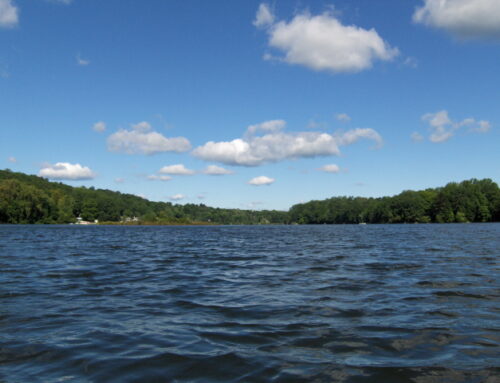

Guest Speakers:: The guest speakers for the evening were Fawn Kearns and Jeff Stahl from Pond and Lake Connection (PLC), our lake management company. Photos of Lake Mamanasco covered in blue-green algae from the summer of 2015 were shown, and it was noted that the lake is in much better shape this year. The CT Dept. of Agricultural Sciences has been conducting a survey of the lake (funded by a Richardson Fund grant) throughout the summer to map aquatic plants in the lake. We will not have the results of this study until November, and PLC will not be giving an exact plan for next year until they see those results.
Jeff Stahl talked about the lateness of receiving our treatment permit. The application was sent to the state on 1/5/16 but the permit was not received until 5/23/16. PLC is trying to get to the bottom of this late permit issuance which has created a problem for management of conditions in our lake for the past several years. On 4/20 PLC checked the lake and saw curly-leaf pondweed growing and by the time of treatment the pondweed had grown to the top of the water. Immediately after receiving the state permit, on 5/26, PLC treated the lake targeting the curly-leaf pondweed. They used products that also bind phosphorus. Fawn showed photos of the lake in April and then again in June after the treatment.
Fawn Kearns gave insight into curly-leaf pondweed and blue-green algae. Curley-leaf pondweed (Potamogeton crispus) is an invasive, non-native, submersed aquatic plant that reproduces by seed. By 5/26, the weed was well past the time at which it should have been treated and had already produced seeds. Fawn noted a correlation between curly-leaf and blue-green algae. When more fully grown, curly-leaf blocks out light that the native aquatic plants need to grow. Lack of aquatic plants may provide a more conducive environment for blue-green algae.
PLC treated the lake six times between 5/26 and 8/18. After each treatment, they came back after five days to check the results. They did eight lake assessments. They maintained ongoing communications with MLIF.
The lake had large mats of filamentous algae in late summer. These mats were not the goal this year as the goal was to keep the lake open and safe with no blue-green algae. The mats are not toxic although unsightly. The water was clear in the summer and that contributed to the excessive growth of the filamentous algae. Next year PLC will target this filamentous algae. The good news is that some native plants such as coontail and native pondweed are coming back.
It was asked how is the best way to combat the curly-leaf pondweed. Fawn answered that we need to treat it earlier and that means obtaining the state permit in a timely manner. PLC can’t send in the DEEP application until Jan. 1. The permit application regarding wildlife (the bog turtle, an endangered species, has been found downstream) was sent last December. MLIF also sent a letter this summer to all the DEEP department heads explaining the problem with getting our treatment permit so late.
A question was asked about the great amount of filamentous algae in the lake. It was noted that the top of the water may look clear but the algae mats under the surface are extensive. Fawn responded that algae is everywhere in lakes, and they are searching for the balance. Algae feed off nutrients in the sediment. More native aquatic plants are needed to absorb the nutrients in the lake. The algae is not rooted and moves with the winds and currents. It was asked if the limited rainfall this year could impact the amount of filamentous algae. Fawn responded that the lack of rain is definitely a factor.
MLIF asked for suggestions for what we can do as a community to help. Fawn responded that it might be best to do another algae treatment in late summer/early fall to reduce the late season algae growth. A question arose as to aeration with a fountain. The answer is that it would be very expensive for a lake our size, and it needs to be in deep water of which we have very little.
At 8:30, our PLC representatives left the meeting and the MLIF monthly Board Meeting took place.
Committee Reports:
Fundraising: We are ahead of last year at this time. An increase in the suggested donation amount probably is the reason.
Spillway: It was reported that this summer/fall the water has not been close to overflowing the tarp. The siphon tubes have been rejiggered.
Drawdown: We will not have our usual two-foot drawdown this year as PLC it is now past the suggested date.
Old Business:
Richardson Grant: The Richardson Grant application included a project to remove dead and dying trees in the lake. In order to decide which trees would be removed using the grant funds, a small committee of board and non-board residents was formed. After deciding what trees to remove, the work was carried out in October. Additionally, a derelict dock was removed. Nearby neighbors were informed of the projects.
“Sponge Park”: It was explained that the project at the Gowanus Canal is not applicable to us.
Lake Video: A video of the lake is still in the planning stage.